About Cyril France
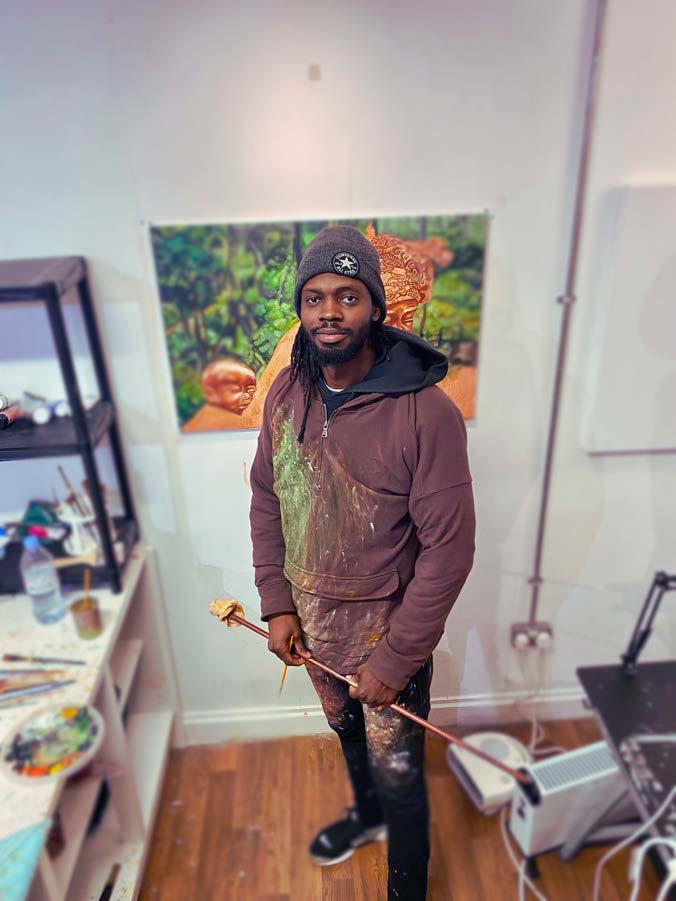
Cyril France
Cyril France is a contemporary figurative painter whose work explores the human figure as a visual language through which psychological presence, interior life, and cultural experience are articulated.
Born in Accra, Ghana and working in the United Kingdom, France draws upon a visual consciousness shaped by both African experience and contemporary British life.
Working primarily with carefully staged compositions, France situates figures within intimate environments where gesture, posture, and spatial relationships convey quiet narratives. Drawing conceptual influence from historical figurative traditions, particularly the expressive language of Mannerism, his paintings engage with contemporary questions of representation, identity, and presence.
His work often focuses on moments of stillness and introspection, presenting figures within domestic or contemplative settings that emphasise dignity, reflection, and psychological depth. Through controlled lighting, colour, and composition, France creates images that invite viewers to consider the body as both subject and language within a broader cultural and emotional landscape.
Download portfolioI see portraiture as a means to impart a social commentary. I began pursuing art in Lockdown 2020. Each work brings attention to an individual of a certain socioeconomic background and outlines underlying political issues by shedding a light on a marginalised person or community. Examining the identities and power struggles within our shared spaces. With my work, I hope to spark up comprehensive conversations with those that see them, no matter where on the globe they may find themselves.
In each of my works, I capture my subjects within a space of ambiguity and poise, inviting the viewer to reconsider what is being prioritised in the visual space. Using a vivid colour palette and intentional compositions, I also assert the idea of co-existence and authority by presenting my subjects in a dominant manner. Working in acrylic on canvas, I use intricate brushstrokes to convey both refinement and vulnerability in the subjects I portray.
About my work
My paintings occupy a space between observation and memory, where I reconstruct the familiar into something quietly uncertain. Working through figurative realism, I create images that initially appear grounded in everyday life, yet resist belonging entirely to a particular moment. My figures inhabit spaces of stillness: sitting, waiting, resting, contemplating. Rather than depicting dramatic events, I concentrate on the quieter moments through which identity, dignity, faith, struggle and hope become visible.
Increasingly, however, I explore narrative not simply through the identity of the sitter, but through the world surrounding them.
In my paintings, a worn chair, faded clothing, dry grass, an old wall, a pair of used shoes, artificial light or the glow of a lantern can operate as more than compositional details. I use these objects as fragments of evidence. They suggest a life beyond the boundaries of the canvas without fully revealing it. I invite the viewer to encounter the aftermath of something, or perhaps the anticipation of something, but rarely give enough information to arrive at a single conclusion.
This ambiguity is central to my visual language. Rather than illustrating a predetermined story, I create the conditions from which stories can emerge. The posture of a figure, the direction of a gaze, an apparently insignificant object or the distance between the subject and their surroundings becomes psychologically charged. For me, meaning exists as much in what I withhold as in what I paint.
In this respect, my realism is not concerned solely with reproducing physical likeness. I use realism as a means of making an imagined world believable enough for the viewer to enter it.
In my compositions, I frequently give Black figures a commanding physical presence while simultaneously revealing moments of vulnerability, contemplation or uncertainty. Through this duality, I complicate conventional representations of strength, allowing monumentality and tenderness to coexist. My subjects do not need to perform their identities for the viewer; instead, I give them space simply to exist.
Between Past and Present
A developing characteristic of my work is the possibility of collapsing distinctions between past and present.
In my work, contemporary objects can exist beside environments that feel inherited, remembered or temporally ambiguous. I may use clothing to evoke one period while another object contradicts it. I place signs of contemporary existence within traditional interiors, allowing natural landscapes, ageing architecture and domestic objects to coexist with unmistakably modern details.
I do not necessarily intend these juxtapositions as historical reconstructions. Instead, I use them to examine continuity. What changes between generations, and what remains?
The objects surrounding us change. Fashion changes. Architecture changes. Technology changes. Yet experiences of waiting, belonging, aspiration, displacement, loneliness, family, faith and hope persist.
I therefore use the past not simply as nostalgia, but as a means of examining the present.
The Poetry of Ordinary Things
Perhaps most significantly, I find narrative potential in the ordinary.
For me, the worn object is important precisely because somebody has used it. The empty chair matters because somebody could occupy it. Faded lettering suggests something once declared more clearly. A lantern does not merely illuminate a figure; it establishes time, intimacy and atmosphere. I see clothing as carrying traces of labour, class, environment and personal history.
I use such objects almost as secondary portraits. They allow me to discuss socioeconomic circumstances without reducing my subjects to those circumstances. I do not need to explicitly announce poverty, aspiration, migration, faith, resilience or social position. Instead, I allow them to be inferred through material surroundings.
Through this restraint, I give the viewer responsibility. I do not ask the audience merely to observe the subject. I ask them to look long enough to begin questioning what they think they know about them.
My paintings consequently exist between portraiture and narrative painting. I document neither a definitive past nor an objective present. Instead, I construct psychologically charged spaces in which memory, contemporary experience and imagined histories overlap.
The images I create are recognisable but unresolved. And it is within that unresolved space that my figures acquire their greatest agency: they are seen, but they are not completely explained.
That distinction is important to me. Through my work, I ultimately propose that to represent someone with dignity is not necessarily to tell the viewer everything about them. Sometimes it is to give them enough presence, complexity and silence to remain unknowable.
Education
Collected works
Private Collection Australia · Doc Rivers · David Biard, Au Cube · Ama Smith · Meir Anavi · Jarrett D Cain · 4BYSIX
Get in touch